The Monarch Butterfly Biosphere Reserve covers 56,259 ha of mountain forest on the Michoacán–State of Mexico border, about 100 km northwest of Mexico City, according to UNESCO. For 2026–27, the sanctuaries are announced to open on November 20, 2026, with visits into March. You need an entry ticket and a local guide.
Choose a named entrance before arranging your trip. The reserve is a wide forest area, and its visitor sites have different access routes. Four sites appear on the confirmed opening list reported by Mexican press; two other familiar names still need confirmation.
Where is the monarch butterfly reserve?
UNESCO’s reserve profile places it in rugged mountains northwest of the capital. The forests cross Michoacán and the State of Mexico, which is a separate state from Mexico City. Our Mexico City guide covers the capital if that is your starting point.
The butterflies gather in oyamel fir forests, forests of evergreen fir trees. They are overwintering here: spending the winter in sheltered colonies, or groups. A sanctuary, called a santuario in Spanish, is a protected place where visitors can observe this natural event under rules.
UNESCO lists a protected World Heritage property of about 13,552 ha, with a surrounding buffer zone of about 42,707 ha. Together these explain the 56,259 ha headline figure. The buffer helps protect the central forest; the whole area is not one visitor park with one gate.
UNESCO describes 14 winter colonies in central Mexico’s oyamel forests. Its listed property protects eight, with an estimated 70% of the eastern population spending winter there. These describe the heritage site’s importance, rather than a list of public entrances. The monarch butterfly migration to Mexico also spans generations: UNESCO describes four successive generations over the spring-to-return journey.
When to go: the 2026–27 season
adn40 and El Universal, citing the reserve and CONANP, announce Friday, November 20, 2026 as opening day. CONANP is Mexico’s national protected-areas agency.
The closing date needs more care. In El Economista’s November 12 report, Michoacán’s governor announces opening through March 31, 2027. El Universal says the natural end depends on conditions and weather, estimating mid-March. Treat March 31 as Michoacán’s announced closing date, rather than a promise of butterfly viewing until that day at every site.
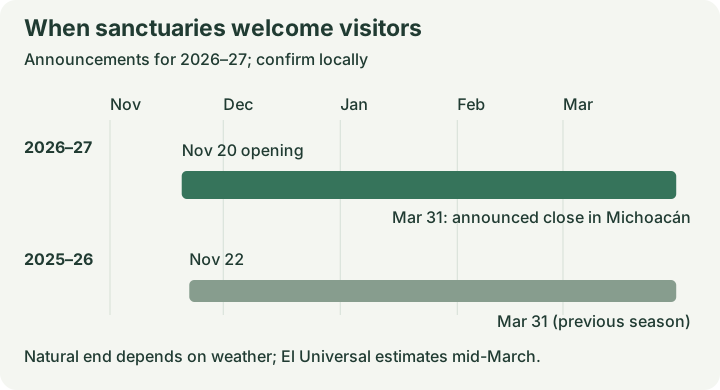 Diagram by Go2Mexico. Source: adn40, El Economista and El Universal (as cited in the text).
Plan for daytime hours. Last season ran November 22, 2025–March 31, 2026, from 8 a.m. to 5 p.m., according to adn40. Those hours are context from last season; confirm this season’s hours locally before leaving. For the rest of your itinerary, see the best time to visit Mexico.
Which sanctuaries are open
The table separates confirmed openings from names still awaiting confirmation. “CONANP-confirmed” refers to the agency’s list as reported by adn40 and El Universal. A parador means the visitor access point or service area mentioned in those reports.
| Sanctuary | State | Municipality | Nearby town and reported time | 2026–27 status |
|---|---|---|---|---|
| El Rosario | Michoacán | Ocampo | Angangueo, about 20 min | CONANP-confirmed in press reports |
| Sierra Chincua | Michoacán | Angangueo | Angangueo, about 25 min | CONANP-confirmed in press reports |
| Senguio | Michoacán | Senguio | Angangueo, about 1 hour | CONANP-confirmed in press reports |
| La Mesa | State of Mexico | San José del Rincón | El Oro / Tlalpujahua, about 1 hour | CONANP-confirmed in press reports |
| Piedra Herrada | State of Mexico | Temascaltepec | Valle de Bravo, about 45 min | Named by state tourism sources; CONANP opening not yet confirmed as of November 8 |
| El Capulín | State of Mexico | Donato Guerra | Valle de Bravo, about 1 hour | Named in tourism coverage; CONANP opening not yet confirmed as of November 8 |
Travel estimates come from El Universal. They are local approach times, not times from Mexico City. Mountain roads make travel slower than a simple distance suggests, so do not use UNESCO’s 100 km reference as a driving estimate.
For a first visit, compare your base town with the confirmed list. El Rosario hosted last winter’s largest measured colony, according to WWF and CONANP. That is useful background, but cannot guarantee this winter’s colony size. Sierra Chincua has a visitor-center route on foot or horseback with a local guide, according to adn40.
El Universal describes Senguio as the smallest and most distant of the three Michoacán visitor sites from Angangueo. For a Valle de Bravo base, Piedra Herrada is a name to check: adn40 places it about 26 km away. Confirm its opening before building a day around it.
How many monarchs arrived last winter
The useful headline is 2.93 hectares of occupied forest, or 7.24 acres, for winter 2025–26. The WWF / CONANP report and WWF México’s results give a 64% increase from 1.79 ha in 2024–25.
This is forest area, not a count of individual butterflies. The researchers map the outer trees of each colony and calculate the area inside that boundary. A hectare figure cannot tell you how many butterflies you will see on your visit.
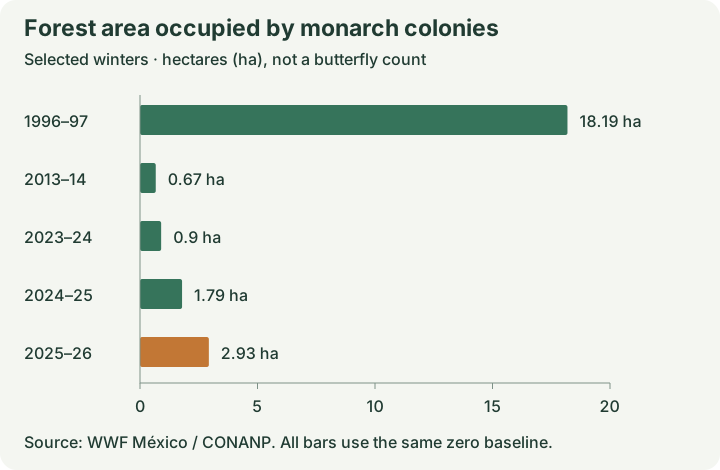 Diagram by Go2Mexico. Source: WWF México and CONANP, selected winter measurements (as cited in the text).
According to WWF México and CONANP, the recorded high was 18.19 ha in 1996–97 and the low was 0.67 ha in 2013–14. The 2023–24 figure was 0.9 ha. These selected years show why a rise from the previous winter should be read alongside the longer record.
The 2025–26 survey recorded nine colonies: three in Michoacán and six in the State of Mexico. Five were inside the reserve and four outside. El Rosario’s colony occupied 1.622 ha, the largest measured that winter. Its land is described as an ejido, a community landholding.
Forest protection remains part of the story. UNESCO identifies illegal logging as a threat because the standing forest shelters the colonies. WWF México also reports forest damage from illegal logging, fire and drought. Larger occupied area in one winter does not remove those habitat risks.
What the visit is like
CONANP’s visitor regulations require both a ticket and a local guide. Expect dirt sections, slopes and altitude above 3,000 m. Wear comfortable shoes such as trainers or boots; the agency notes that the ground can be slippery.
At Sierra Chincua, adn40 describes travel from the visitor center on foot or horseback with a local guide. Do not assume that the same arrangement applies at every entrance. Ask about the route at the site you choose.
For an explanation of height above sea level, use our Mexico City altitude guide. The sanctuary trail is higher than the capital’s average. CONANP asks visitors with health problems to tell their guide. This is a mountain walk with a short observation stop at the colony, so allow for more than the viewing minutes alone.
Rules inside the sanctuary
Follow CONANP’s regulations and CONABIO’s visitor code, alongside your guide’s instructions:
- Stay on marked trails and respect the permitted distance from colonies.
- Keep silent. CONABIO explains that noise interrupts the butterflies’ rest and makes them use energy.
- Turn flash off. Repeated flashes can disturb resting butterflies and cause them to leave their clusters, according to CONABIO.
- Do not touch, disturb, catch or take butterflies, including dead ones.
- Leave plants, animals and other forest material where they are. Take no natural souvenirs and leave no litter.
- Bring no pets or alcohol. Do not smoke or light fires. Sharp objects and firearms are prohibited.
- Bring no food onto the trail or into the sanctuary. CONANP lists exceptions for bottled water and citrus fruit; follow local instructions on their use.
- Keep the observation stop short: CONANP says a maximum of 20 minutes at the colony. CONABIO’s code says no more than 18 minutes in the sanctuary.
The time rules use different wording and limits. Follow the guide’s instructions rather than treating either figure as extra time you can claim. CONABIO links shorter stays to letting others visit while limiting disturbance to the resting colonies.
Entry fees and what to bring
Mexican press reported adult entry of MXN 150, MXN 100 for children aged 6–12, and free entry for children under five at El Rosario, Sierra Chincua, Senguio and La Mesa for 2026–27. These are reported prices from adn40 and El Universal; confirm at the entrance.
The reported age bands leave age five unclear. Ask the entrance staff if that applies to your group. These figures do not establish the price of horseback access or any other service.
Keep your trail preparation simple: comfortable walking shoes and bottled water fit CONANP’s rules. Citrus fruit is the stated food exception. Check food restrictions before starting the trail, and keep waste for the designated bins. For broader trip preparation, see our travel insurance guide.
Frequently asked questions
When does the 2026–27 season open?
Mexican press reports citing the reserve and CONANP announce Friday, November 20, 2026. Michoacán has announced visits until March 31, 2027, but the natural end depends on weather; confirm locally.
Which sanctuary should I choose for a first visit?
El Rosario hosted the largest measured colony last winter. Sierra Chincua offers access from its visitor center on foot or horseback with a local guide. Both are on the confirmed opening list reported by Mexican press.
Do I need a guide?
Yes. CONANP requires both an entry ticket and a local guide. Stay on the marked trail and follow the guide’s instructions.
How long can I stay with the butterflies?
CONANP sets a maximum of 20 minutes at the colony. The CONABIO visitor code says no more than 18 minutes in the sanctuary. Follow your guide’s time and distance instructions.
How far is the reserve from Mexico City?
UNESCO places the reserve about 100 km northwest of Mexico City. That is a location reference, not a road distance or journey time to a particular sanctuary.
Season dates and fees are announcements and press reports. Confirm the chosen sanctuary’s opening, hours and charges locally before travel. Sources checked November 13, 2026.