Mexico City's average elevation is 2,240 meters, or about 7,350 feet, according to INEGI and the city government. That is just below the CDC's usual 8,000-foot / 2,450-meter line for altitude-illness risk, which can also start lower. Higher parts of the city and trips into the Ajusco range sit above that line.
Altitude and elevation both mean height above sea level in this guide. CDMX is the short name for Mexico City. For the wider destination, see our Mexico City guide.
How high is Mexico City?
INEGI's 2024 geographic compendium gives an average height of 2,240 meters above sea level. The Mexico City government lists the same figure and gives its rounded equivalent as 7,350 feet.
The valley is not flat. INEGI lists these reference heights:
| Place or reference | Meters above sea level | What the figure describes |
|---|---|---|
| Mexico City average | 2,240 m | Average, not every street |
| Cuauhtémoc | 2,230 m | Entry in INEGI's borough table |
| Chapultepec hill | 2,280 m | Hill, not the whole park |
| Cerro de la Estrella | 2,450 m | Hill |
| Cuajimalpa de Morelos | 2,780 m | Entry in INEGI's borough table |
| Volcán Ajusco | 3,930 m | Mountain summit |
A borough, called an alcaldía locally, covers an area. Its listed height is not a promise about the elevation of a particular hotel.
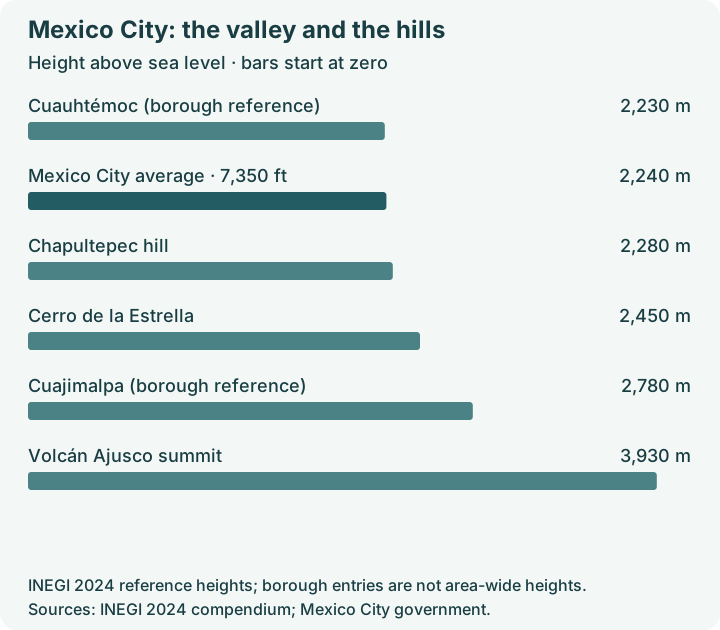 Diagram by Go2Mexico. Source: INEGI / Mexico City government / CDC, figures as cited in the text.
For the Mexico City altitude vs Denver question, start with the nickname: Denver is the Mile High City. One mile is 5,280 feet. Subtract that from Mexico City's listed 7,350 feet and the difference is about 2,070 feet above one mile. This compares Mexico City with the nickname, rather than a specific Denver street.
Mexico City altitude in feet and meters
The short answer in feet is about 7,350 ft. In meters it is 2,240 m. These describe the same average height, using the city government's rounded conversion. They are not two different measurements of the city.
Keep the units visible when comparing places. The table uses meters because INEGI reports those heights in meters. The CDC gives both units for its risk line. A hotel listing in feet and a hiking map in meters may look very different until you compare them in the same unit.
Does the elevation cause altitude sickness?
It can, but the city average alone cannot predict who will feel ill. The CDC Yellow Book, 2026 edition, on its page dated April 23, 2025, identifies risk for travelers who have not adjusted to a sleeping altitude of at least 2,450 meters / 8,000 feet. It adds that risk sometimes begins lower.
Sleeping altitude means the height where you spend the night. Acclimatization means your body adjusting to altitude. The city's average is 210 meters, or about 650 feet, below the CDC line, using the sources' rounded figures. That line is a guide to risk, not a guarantee against illness below it.
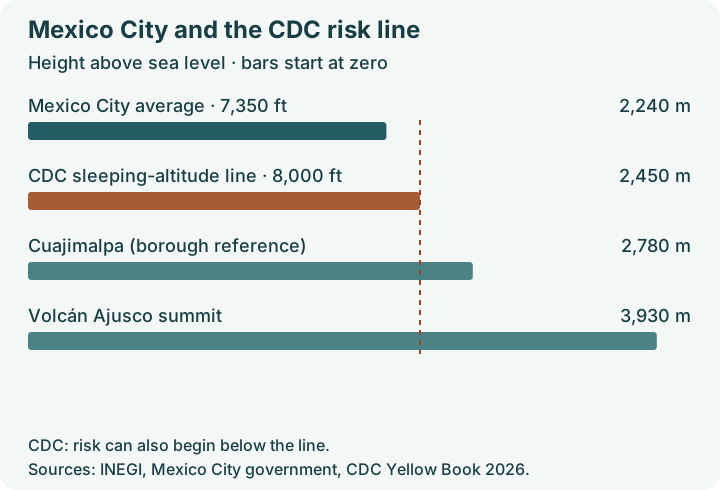 Diagram by Go2Mexico. Source: INEGI / Mexico City government / CDC, figures as cited in the text.
Acute mountain sickness, or AMS, is the mildest form of altitude illness. CDC describes headache, usually with another symptom such as nausea, dizziness, tiredness, or loss of appetite. Vomiting can also occur. There is no sourced Mexico City visitor percentage in this guide.
Fitness does not protect you, according to CDC. Children are as susceptible as adults. CDC reports slightly less risk in people older than 50, but age cannot tell an individual traveler whether symptoms will occur.
What you might feel in the first day or two
Headache, unusual tiredness, nausea, and less interest in food fit the CDC's symptom list. They are possibilities, rather than an expected part of every visit. A headache alone does not establish AMS.
CDC says AMS usually starts within 2–12 hours of arrival at altitude or a further ascent. It often appears during or after the first night. It generally clears within 12–48 hours if the traveler goes no higher. That timing is not a reason to wait through worsening symptoms. CDC also cautions against calling new symptoms AMS when they start after three days without further ascent.
The CDC traveler guidance advises avoiding alcohol and heavy exercise for at least the first 48 hours after arriving above 8,000 feet. Mexico City's average sits just below that level. This is general high-altitude guidance, not a city-specific rule or a promise that everyone adjusts within that time.
For a family itinerary, use our Mexico with kids guide. CDC notes that children who cannot yet describe symptoms may seem fussy or lose their appetite.
Higher neighborhoods and day trips
INEGI's Cuajimalpa de Morelos reference is 2,780 meters. Volcán Ajusco reaches 3,930 meters. Both are above the CDC risk line. Cerro de la Estrella, at 2,450 meters, meets that line. Check the actual place you plan to visit or sleep, rather than applying the city average everywhere.
A hike toward Ajusco is a further ascent after a stay in the valley. CDC warns that people who have already adjusted can face renewed risk when moving to higher sleeping elevations, especially after gains of 600–900 meters. This warning concerns sleeping higher; a summit visit and an overnight stay are different exposures.
CDC describes day trips followed by sleep at a lower elevation as less stressful than sleeping high. That does not make a high hike risk-free. If symptoms develop, the CDC's advice is to stop going higher. Our Mexico City neighborhoods guide covers where to base yourself; use the elevation of your actual accommodation when planning a higher stay.
How this compares with beach towns and Colorado ski towns
Caribbean beach resorts are at or near sea level. Moving from a beach stay to Mexico City is therefore a climb to the valley's elevation. Being on the same Mexico trip does not mean you have already adjusted to altitude.
Colorado ski towns offer a different comparison. The CDC Yellow Book uses Vail lodging at 2,480 meters / 8,150 feet as a high-altitude example. That is above Mexico City's 2,240-meter average and above the CDC risk line. The comparison refers to lodging, not the top of a ski mountain.
For weather and season choices, see when to visit Mexico. Altitude planning and weather planning answer different questions; a pleasant forecast does not establish how you will respond to a higher sleeping elevation.
When to slow down or get help
The CDC gives three central rules: recognize early symptoms, never go higher to sleep while symptoms persist, and descend if symptoms worsen despite rest. Its traveler page also says to avoid further ascent until symptoms are gone.
Know the urgent signs of the serious forms CDC describes:
- HACE, swelling of the brain, can cause confusion, marked drowsiness, or loss of coordination. CDC calls it rare, especially below 4,300 meters.
- HAPE, fluid in the lungs, can cause shortness of breath, weakness, and cough. It is uncommon at Mexico City's average elevation, but suspected symptoms need urgent attention.
CDC says these serious forms require immediate descent; HAPE often also needs oxygen. Seek emergency medical help rather than treating severe symptoms as routine adjustment.
People with existing health conditions should discuss high-altitude plans with a doctor, as CDC advises. This includes heart or lung disease, diabetes, pregnancy, and sickle cell disease. Medicines exist, but the choice belongs in that conversation; this guide provides no doses or schedules.
For broader preparation, see Mexico travel safety and health and our travel insurance guide.
Frequently asked questions
How high is Mexico City?
Mexico City's average elevation is 2,240 meters, or about 7,350 feet, according to INEGI and the Mexico City government. Individual places within the city can be higher or lower.
Is 7,350 feet high enough for altitude sickness?
It can be. The CDC places altitude-illness risk at a sleeping altitude of 8,000 feet / 2,450 meters and sometimes lower. Mexico City's average is just below that line, so it does not rule out symptoms.
How does Mexico City altitude compare with Denver or one mile?
Denver is known as the Mile High City. One mile is 5,280 feet. Mexico City's listed elevation of 7,350 feet is about 2,070 feet above one mile; this compares with the nickname, not a measured Denver address.
Does fitness protect against altitude sickness?
No. The CDC says training and physical fitness do not change altitude-illness risk. Children are as susceptible as adults. Being fit does not remove the need to watch for symptoms after going higher.
What about Ajusco or higher neighborhoods?
INEGI lists Cuajimalpa de Morelos at 2,780 meters and Volcán Ajusco at 3,930 meters. Both are above the CDC's 2,450-meter line. These are reference elevations, not the height of every hotel or every point on a hiking route.
This guide is general travel information, not personal medical advice. Discuss health concerns and higher-altitude plans with a qualified clinician. Sources checked November 8, 2026.